Today we commemorate another special occasion related to languages, namely the International Translation Day. Why today? Because on 30th September the Catholic Church holds the feast of St. Jerome, the Bible translator who is considered the patron saint of translators and interpreters. This is a perfect opportunity to display pride in a profession that is gradually becoming increasingly essential in the era of progressing globalisation. And I take pride in the fact that I am a part of this community :)

The patron saint of translators at work
Instead of describing the very idea and history behind this event, I’ve decided to touch upon an interesting question, namely: how is this profession perceived and portrayed in the contemporary world, including the cinema industry?
Even though the profession of translators and interpreters is one of the oldest ones in the world, it is still little known to many people.
I’m wondering whether you would be able to name any films, whose protagonists work in translation industry? Well, I suppose it might be quite a challenge, seeing that this profession seems seriously underestimated. And yet, I’ve managed to encounter some brilliant examples of translators or interpreters in various films. That is why I’ve compiled my top five films, involving film translators and interpreters, which I would like to present you in this article. Let’s get started, shall we ? :)
I’m wondering whether you would be able to name any films, whose protagonists work in translation industry? Well, I suppose it might be quite a challenge, seeing that this profession seems seriously underestimated. And yet, I’ve managed to encounter some brilliant examples of translators or interpreters in various films. That is why I’ve compiled my top five films, involving film translators and interpreters, which I would like to present you in this article. Let’s get started, shall we ? :)
5. “Lost in Translation” (2003)
The title of the film can be interpreted in two ways:
a) because of the language barrier, which makes the major protagonists (Americans) feel excluded and alienated in a foreign country (Japan), who literally get lost in a giant city (Tokio) without being able to speak Japanese…
b) we get very lengthy explanations in Japanese (uttered by the Japanese director), which are consecutively interpreted in very few words by the interpreter to the American actor (Bill Murray), playing in an advertisement. Apparently, the interpreter doesn’t convey the entire original message because of cultural and ethical reasons, since it contains rude orders. "That's all he said?" asks the character played by Bill Murray. Eventually, it leads to the complete lack of communication between the two of them… That is why interpreters are crucial in the process of communication across various cultures.
4. Romy Schneider “Les choses de la vie” (1970)
Well, I could not help but mention this exquisite actress, seeing that I am an avid fan of her. It was her outstanding portrayal of empress Elisabeth of Austria (Sisi) that made me attached both to her and the historic figure she portrayed. I would not exaggerate if I said that if it hadn’t been for Romy Schneider, we would not probably even get to know the empress. And I would not establish my blog about her either…
But I’m digressing now, so let’s focus on Schneider’s performance in 1970. Here she plays Helene, a translator, who wakes up in the morning and starts translating a novel on a typewriter. That makes us remember the old-school fashion of translating, huh?
Helene seems extremely focused on her work, and yet spectators have to notice that she is an embodiment of one-of-a-kind sex appeal. And so does her film partner, who eventually tries to seduce her in a very charming way, distracting her from her work, while she struggles with translating a novel from German into French. The problematic word is the German verb verschönern (brightening something up / beautifying), but Helene’s friend comes to her aid with the French equivalent (afabuler). That’s what happens, when you are stuck and cannot call to mind this particular word. To make matter worse, it must have been so hard for the translators not to be able to make use of multimedia dictionaries or re-edit their text, just as we are nowadays…
That scene went into the history of the French film. Summing up, even though Schneider portrays here only a minor aspect of her protagonist, she does it in a magnificent, eye-catching and unforgettable way. And so she does in her every single film.

3. Olga Bołądź “Czas Honoru” (“The days of Honour”; 2008-2013)
To the uninitiated, this well-received and hugely popular TV-series describe the story of the Polish elite soldiers Cichociemni and their fellow companions, involved in the resistance movement in Poland during world war 2 within the Home Army. One of them is Celina, a charming and brilliant translator. She speaks Polish, German and English, and these were three languages were vital when it comes to the intelligence operations back then. And she makes use of them in a very sophisticated way, managing to mislead the Nazi Germans on a number of occasions, succeeding in pretending to be of German origin, and impressing the Americans with the impeccable quality of her translations.

We don’t actually get many details related to her professional career, except for the fact that she has studied German literature in Berlin just before the outbreak of the war. Afterwards she works in a publishing house, where she puts her heart and soul in translating world-famous novels into Polish. Nevertheless, being a genuine patriot, she finally gets rid of a job, as she is aware of the fact that her assignments serve for the purpose of the communist regime.
Her most important performance involved her cooperation with the American Intelligence Service, where she was commissioned to translate the testimony of the Nazi criminals during the Nuremberg trials. Despite the fact that Celina wasn’t probably personally involved in the very act of interpreting, her performance makes us remember the historical importance of these trials, which marked the very beginning of the idea behind simultaneous interpreting. It also makes us aware that excellent translators and interpreters are worth their weight in gold at war time.
2. Audrey Hepburn “Charade” (1963)
Audrey plays an interpreter for the UN, who finds herself in a quite dangerous situation, as her husband dies in mysterious circumstances, leaving her surrounded by criminals and agents. Her performance provides us with an insight into the beginnings of simultaneous interpreting, including the equipment of a typical interpreter’s booth of that era.
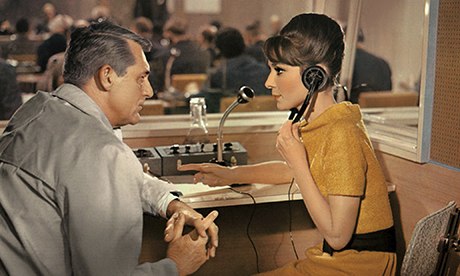
Despite the fact that the interpreter’s role played by Audrey seems rather minor, hilarious and highly unprofessional in equal measure (since she interrupts her performance at the conference by a private conversation with her friend and suddenly leaves the booth with no excuse whatsoever!), we can forgive her anything – she was a truly glamorous and a mighty talented actress. She was definitely one of the most elegant interpreters I’ve ever seen...
1.Nicole Kidman “Interpreter” (2005)
In this film, at last, the interpreter is in the limelight. The major protagonist, played by the charismatic Nicole Kidman, works as an English interpreter at the United Nations in New York (so you can see some paralleled qualities shared with Audrey Hepburn’s protagonist). She understands a very rare language (of a mysterious name: ku) and overhears a conversation between two delegates speaking that language, which gets her into serious trouble…
A must-see for every (future) interpreter, although it’s not very likely that you should experience such dangerous adventures, as Nicole’s protagonist did… Still, it’s quite thought-provoking and raises our awareness about the importance and possible far-reaching consequences of an interpreter’s behaviour, who has to be precise and accurate at all times. Kidman’s excellent performance intensifies a highly-strung atmosphere of political events, in which interpreters happen to be involved, so that spectators begin to sense the importance of this job from the very beginning of the film.

***
I would thoroughly recommend all the above mentioned films to all of you, especially if you’re interested in learning more about translators’ and interpreters’ job. This list could go on and on, as there are many more films, in which the major characters are interpreters or translators, but I didn’t include them, seeing that I haven’t seen them yet. Still, if you want to find out more, click here. I sincerely hope we will see more films dedicated to our profession, as we really deserve it.
Do you feel that translators and interpreters are given enough attention in the present-day society, including the film industry? Do you happen to know any other examples of film portrayal of this profession? I would love to know your opinion on that subject. The stage is yours.
Happy International Translation Day to all of you!
May St. Jerome guide us at all times! :)
May St. Jerome guide us at all times! :)
Images taken from:
ciekawostkihistoryczne.pl; graffitiwithpunctuation.net; tumblr.com; images1.villagevoice.com; s-media-cache-ak0.pinimg.com; vignette3.wikia.nocookie.net/czashonoru/; s.tvp.pl; static.guim.co.uk; www.cetra.com; dailyman40.com

basically translator and interpreters have perform the duties written and oral. translator has required a time for translate the document into target language and interpreters has communicate on the spot without any problem.
OdpowiedzUsuńDocuments Translation Services